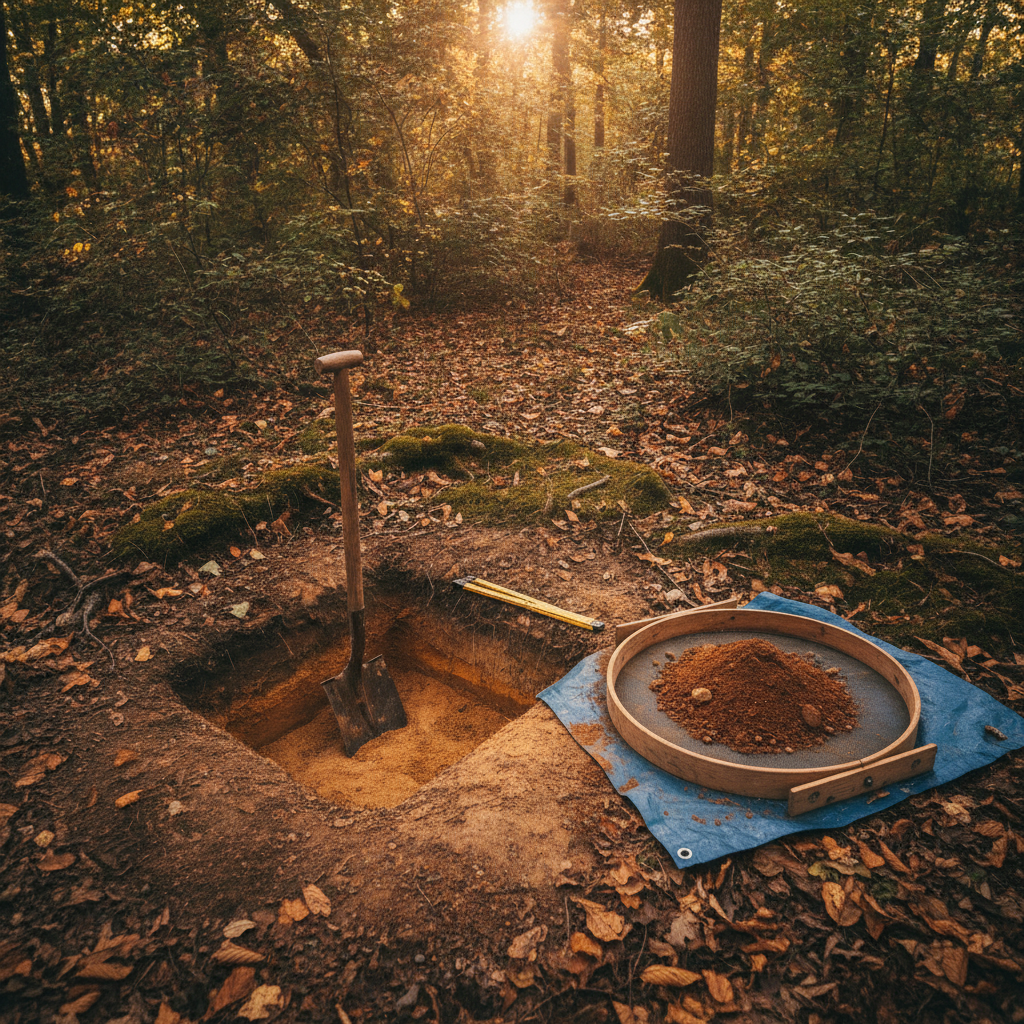
Shovel test pit (STP) survey is the workhorse of Phase I archaeology in vegetated regions — and the single largest source of repetitive recording in CRM. A moderate survey means hundreds of tests; a large linear project means thousands. How you record them determines whether your field data becomes a clean report or a transcription nightmare.
This guide covers the recording standards that keep STP data defensible, and the workflow changes that make it fast.
STP Spacing and Grid Basics
Most state guidelines specify testing intervals, commonly:
- 30 m (100 ft) — the default interval for most Phase I pedestrian survey in the eastern US
- 15 m (50 ft) — high-probability areas, site delineation, or some state minimums
- 7.5 m or 5 m — close-interval delineation once a site is identified
Check your state's survey standards before proposing anything — several SHPOs publish required intervals by landform probability, and reviewers notice when a report doesn't match them. Transects are typically laid out along a compass bearing with tests numbered sequentially (T1-STP1, T1-STP2…), which keeps provenience unambiguous when crews leapfrog.
What to Record at Every Test — Positive or Negative
The biggest documentation failure in STP survey is thin negative data. A negative test is evidence, and reviewers treat it that way. At minimum, record for every test:
- Test identifier and GPS coordinates — sequential ID plus a real coordinate fix, not just a tick on a paper map
- Excavated depth and reason for termination — sterile subsoil, water table, rock, roots, or maximum depth reached
- Stratigraphy — depth, Munsell color, and texture for each stratum
- Disturbance observations — plow zone, fill, push piles, drainage
- Result — positive or negative, with artifact counts and classes if positive
- Recorder and date
For positive tests, add artifact provenience by stratum or arbitrary level, and note whether material was collected or observed and returned.
Where the Time Actually Goes
Time-motion studies from our own users are consistent: digging a 30×30 cm test to sterile takes 10–20 minutes; recording it on paper takes 3–5; transcribing that paper form back at the office takes another 3–5. On a 400-test survey, transcription alone is 20–30 staff hours — pure overhead that produces nothing except new typos.
The digital fix isn't exotic. A well-built STP form:
- Auto-fills the boring fields. Test number increments automatically; GPS, date, and recorder attach themselves.
- Uses dropdowns for controlled values. Munsell colors, texture classes, and termination reasons become two taps instead of freehand text that has to be standardized later.
- Handles strata as repeatable rows. Add a stratum, not a second form.
- Works with zero signal. STP survey happens in exactly the places cell coverage doesn't. Records must save on-device and sync later (here's how FieldTap handles offline).
The result is that recording drops to about a minute per test and transcription drops to zero — the data is already structured, so the shovel test table in your report is an export, not a data-entry project.
Producing the Deliverable
A Phase I report needs the STP data three ways: a summary table (every test, result, depth), a distribution map, and — in many states — site forms for any positives. If your records carry real coordinates and structured fields, all three fall out automatically: CSV/Excel for the table, shapefile or KML for the map, and state site forms filled directly from the records for the positives.
A Checklist to Steal
Before your next survey, confirm:
- Testing interval matches the state standard for each probability zone
- Every test gets a coordinate fix, not a map tick
- Negative tests get full stratigraphy, same as positives
- Munsell colors and textures come from a controlled list
- Termination reason is recorded for every test
- Artifacts are provenienced by stratum before the hole is backfilled
- Data leaves the field structured — no transcription step
FieldTap ships with ready-made shovel test forms (and 120+ other field forms) that implement all of this out of the box — try it free for 14 days on your next survey.